Sovereignty is a control plane property
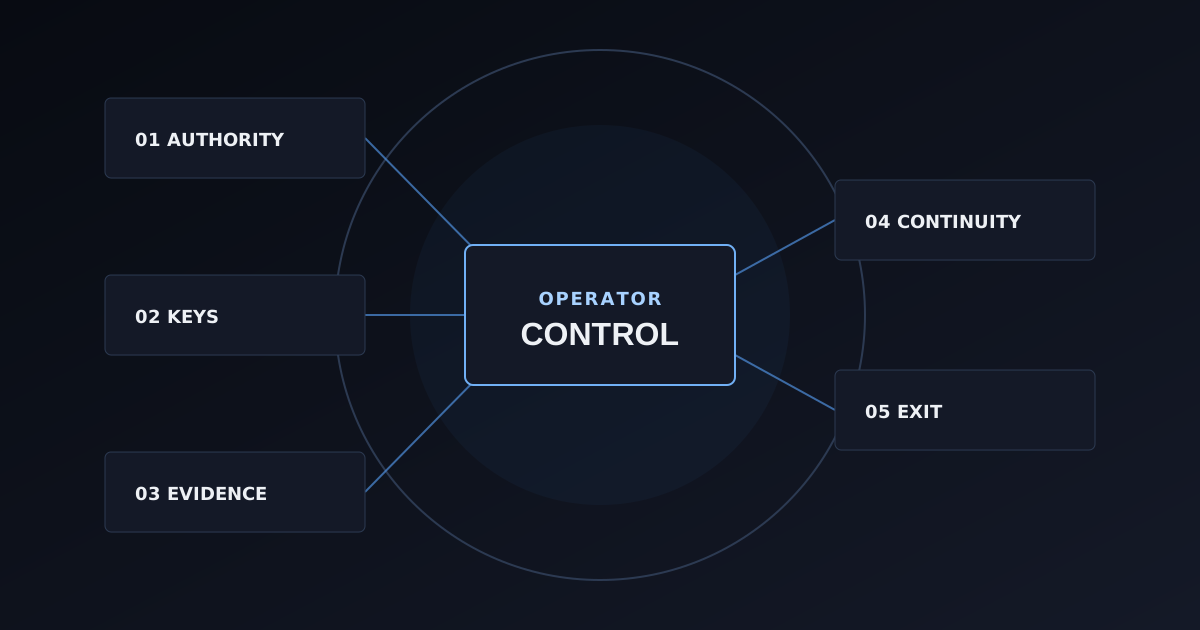
Suppose a workload runs in Frankfurt and its data stays there. Location alone does not tell you who can grant administrative access, unwrap a disk key, replace the software that runs the cloud, alter its audit trail or restore it when something fails.
Those are control plane questions. A cloud is sovereign only when its operator has the authority, keys, software and knowledge to keep it running without asking an outside party for permission. The operator must also be able to move or retire the platform without losing access to its data, configuration or control plane state.
Moving a component into the operator’s data center does not necessarily move control with it. It may still depend on an identity issuer, key service, container registry, certificate authority or recovery process controlled by someone else. Self-hosting one component often exposes the next dependency.
I find five concrete tests more useful than arguing over whether a cloud deserves the word sovereign. Together they cover authority, key custody, evidence, continued operation and exit. They are not a certification scheme. Each test starts with a specific dependency or failure. Without that, a claim of independence is too vague to test.
Follow the control path
A claim of independence should say what the operator needs to do on its own and what must still work when an outside service is unavailable. Can the operator patch and restart the platform without help from its supplier? Can it prevent the infrastructure provider from decrypting a disk? Can it move workloads and control plane state elsewhere? These are different claims, and they need different evidence.
Take an ordinary request to create a machine. The user authenticates to an identity service. An API evaluates policy. A controller calls the infrastructure provider. A key service may release a key for the disk. An audit service records what happened. The software running those services came through a build and release system. Those connections also depend on DNS, certificates and accurate time.
I follow the request through every system that can authorize it, carry it out or record what happened. For every system on that path, I want to know who operates it, who holds its administrative credentials, which keys it can use, and what happens when it becomes unavailable. I also want to know whether the operator can replace it without losing access to existing workloads or data.
An external dependency is not automatically a problem. An organization may deliberately use a federated identity provider or rely on its software supplier for updates. That is fine, but it sets a limit on what the operator can claim. The operator is not independent of a service it still needs to administer or recover the cloud, decrypt its data or verify its evidence.
1. An external party cannot grant itself operator authority
Identity comes first because every other control depends on who is allowed to act. Running an identity service locally does not prove that the operator controls administrative access. There may still be a vendor support account, a remote recovery service or another issuer whose tokens the platform accepts for administrative access.
Scope matters as much as authentication. If an API accepts a tenant or project identifier from the caller and treats it as fact, a valid credential may be enough to cross a boundary. The platform has to derive that scope from trusted identity and resource state, then apply policy to the result.
The exceptions deserve more attention than the normal path. A break-glass identity may be necessary, but who can activate it? Is its use time-bounded and recorded? Can the operator disable it without help from the outside party that controls it? A permanent vendor credential hidden behind the words “support access” is still an external root of authority.
Start with a credential for an identity that has no permissions and prove that the requested operation is denied. Grant that identity permission for one narrow action and prove that it works. Revoke the credential and prove that it stops working. Then try to cross into another tenant or project by changing the request data. Finally, inventory every path that can create an administrator, recover an administrative account or impersonate one.
This does not require every organization to build its own identity provider. Federation can be a deliberate and sensible dependency. But the operator should control which issuers are trusted, be able to revoke that trust, and retain a recovery path that the external issuer cannot override.
2. The operator can allow or withhold decryption without surrendering key control
Encryption at rest says that stored data is ciphertext. It does not say who can turn it back into plaintext.
Many cloud disks use envelope encryption. A data encryption key encrypts the disk, while another key wraps that data encryption key. The second key is the one a customer or operator may keep in its own key service. It does not touch every disk block, but control over it decides whether the platform can unwrap and use the data encryption key.
This leaves two questions: who holds the wrapping key, and who is allowed to use it? Keeping the key in an operator-controlled HSM is not enough if one broadly trusted platform credential can unwrap every disk key. The policy must also bind each request to the workload and resource it belongs to. An HSM, or hardware security module, protects the key material. By itself, it does not decide which workload should be allowed to use which key.
Test this by making the operator-controlled key service unavailable while the rest of the platform remains healthy. A fresh attempt to open the disk or start a machine that uses it should fail because the platform cannot unwrap the disk key, not because the whole control plane has been stopped. Restore access to the wrapping key, then read the same data from the disk.
The same test also shows where that control ends. Withdrawing access prevents the platform from obtaining the disk key again. It cannot take back plaintext or key material already held by a running host. Deleting the key is not a stronger custody test either. It may only prove that the operator can make its own data unrecoverable.
3. The operator can retain and independently verify evidence
An audit page is useful during normal operation. It is weak evidence when the same control plane stores the events, answers the query and decides whether its own answer is valid.
The operator needs to take evidence away from the producer. That usually means exported events, signed receipts, retained verification keys and a verifier that can run independently. Signatures make changed events detectable. Linking each receipt to its predecessor exposes gaps within the sequence. A trusted checkpoint is also needed to detect events removed from the end.
Failures belong in the evidence too. A trail that records successful administrative actions but omits denied requests, attempts with revoked credentials or unauthenticated requests leaves a gap when investigating an attack or a broken policy rollout. If an unauthenticated request says it came from Alice, the audit record must not list Alice as a verified user.
Export a short run of events together with the material needed to verify it. Make three copies. Change a field in the first, alter a link in the second and remove the final event from the third. An independent verifier should reject each copy without contacting the original service. Then rotate the signing key and show that the older evidence remains verifiable.
I use tamper-evident rather than immutable. A signature does not stop someone from deleting a file. A hash chain can reveal a missing event only if the verifier has a later link or a trusted checkpoint to compare against. The design still has to say who retains that checkpoint, which events are included and how long the evidence is retained.
4. The operator can continue without outside services
Installing software in the operator’s data center is not the same as making it independent. A platform may run happily for months and still fail its first restart without a public container registry. Certificate renewal may depend on an external authority. Hosts may depend on public time servers or DNS resolvers. An upgrade may fetch a chart, package or vulnerability database that was never included in the delivery bundle.
These dependencies are easy to miss because they sit outside the main request path. They appear during installation, restart, scaling, certificate rotation, upgrade and diagnosis. Each of those operations needs its own disconnected test. “It runs without internet access” is too broad to be useful unless it says which operations were exercised and for how long.
The operator should already possess the deployment intent, artifacts, trust roots and instructions needed to recover the platform. Release signatures must be verifiable without calling the vendor. The artifact inventory has to come from rendered deployment manifests rather than a handwritten list. Charts often introduce images that are invisible in the top-level bill of materials.
Provider failure is another useful drill. Remove access to the infrastructure API and observe what happens to reads, writes, background reconciliation and health checks. A control plane may correctly keep serving its local view while refusing new changes. It may also report itself healthy while workers accumulate requests that can never finish. Both behaviors are invisible in an architecture diagram.
Writing the operational runbooks is part of this test. A rollback procedure that says “restore if necessary” has moved the hard question into two words. Write the commands, inputs, ordering and expected state. Every step that has to be invented while writing the runbook is unresolved engineering work.
5. The operator can recover, move and retire the platform through tested procedures
Portability often stops at an API boundary. Business logic is separated from a provider adapter, the interface looks clean, and the design is declared portable. That is useful design evidence. It is not the same as moving a running system.
An exit carries more than workload disks. The operator may need identity and policy state, key metadata and recovery material, audit evidence, DNS, certificates, deployment configuration and the trust roots used to accept a release. The target platform also has to provide equivalents for the infrastructure features on which the workload relies. A second provider with a different storage or network model can satisfy the same API only by making those differences explicit somewhere.
Recovery exposes a related problem. Suppose the control plane database is restored to yesterday. Machines and volumes created after that backup may still exist in the infrastructure provider, but the restored control plane no longer knows that it owns them. A successful database restore can therefore create orphaned resources. Unless the platform can rediscover and reconcile them, backup is only part of the recovery plan.
A serious exit test starts with a clean control plane, imports the required state and reconciles it with what actually exists. If support for multiple infrastructure providers is claimed, the test should use a real second adapter rather than treating the interface itself as proof. The final phase removes support identities tied to the old platform, removes any former supplier’s signing keys from the trust store and revokes its access to key services. Until those steps have been run, the exit path is a design, not an operating capability.
A ten-question sovereignty review
These are the questions I would use to start a technical review:
- Who can grant administrative access, recover an administrator account or impersonate one? Can the operator revoke every external access path?
- Are tenant, project and resource scope derived from trusted state or accepted from the caller?
- Who can cause a data encryption key to be unwrapped, and which system enforces that decision?
- Can the operator withdraw and restore key access without destroying the key or taking the whole platform down?
- Can audit evidence be exported and verified without asking the system that produced it?
- Can the verifier detect altered or omitted events, and does the evidence include failed and denied requests?
- Which critical operations stop when vendor services or public internet access disappear?
- Can the operator rebuild from artifacts, trust roots and instructions it already possesses?
- Can the operator restore control plane state and reconcile resources created outside the restored database’s view?
- Has an exit rehearsal proved that the operator can move its data, keys, identity and evidence to another platform? Can it establish the same operator authority on the new platform, retire the old one and revoke every remaining access path?
Data residency still matters because it tells operators and users where data is kept. It does not say who controls the systems that can access, move or recover that data.
Open infrastructure helps because it can be inspected, operated and replaced. That gives the operator more ways to remain independent, but it does not supply the skills, artifacts or recovery procedures by itself.
I would not accept any of these claims from a diagram alone. Revoke an administrator’s credential. Withhold access to a key, then restore it. Show that an altered audit record fails verification. Disconnect the external dependencies. Rehearse the exit. Until those tests have been run, sovereignty is still an architectural intention, not an operating property.